
Introduction
At the Radiological Society of North America (RSNA) annual meeting, researchers unveiled a breakthrough in breast cancer prediction. An advanced artificial intelligence (AI) model was shown to outperform traditional breast density assessments in identifying a woman’s long-term risk for developing breast cancer. This finding marks a major shift in screening strategies and highlights how AI can provide more precise and personalized healthcare.
Why Breast Density Has Been the Traditional Risk Indicator
Breast density refers to the amount of fibroglandular tissue compared to fat in the breast. Women with high breast density:
Have a higher chance of developing breast cancer
May have tumors hidden on mammograms due to dense tissue
Often require additional imaging
Until now, breast density has been one of the strongest imaging-based predictors of breast cancer risk. However, density assessment is subjective, varies between radiologists, and provides limited detail about the underlying tissue. These limitations opened the door for more advanced methods like AI.
How the AI Model Works
The new AI model presented at RSNA is trained on thousands of mammograms paired with real patient outcomes. It analyzes:
Pixel-level tissue patterns
Texture and microstructures
Subtle abnormalities invisible to human eyes
Tissue distribution and biological markers
Historical imaging data
While breast density only measures how “dense” the breast appears, the AI model evaluates deep, complex imaging features that provide a more detailed picture of cancer risk.
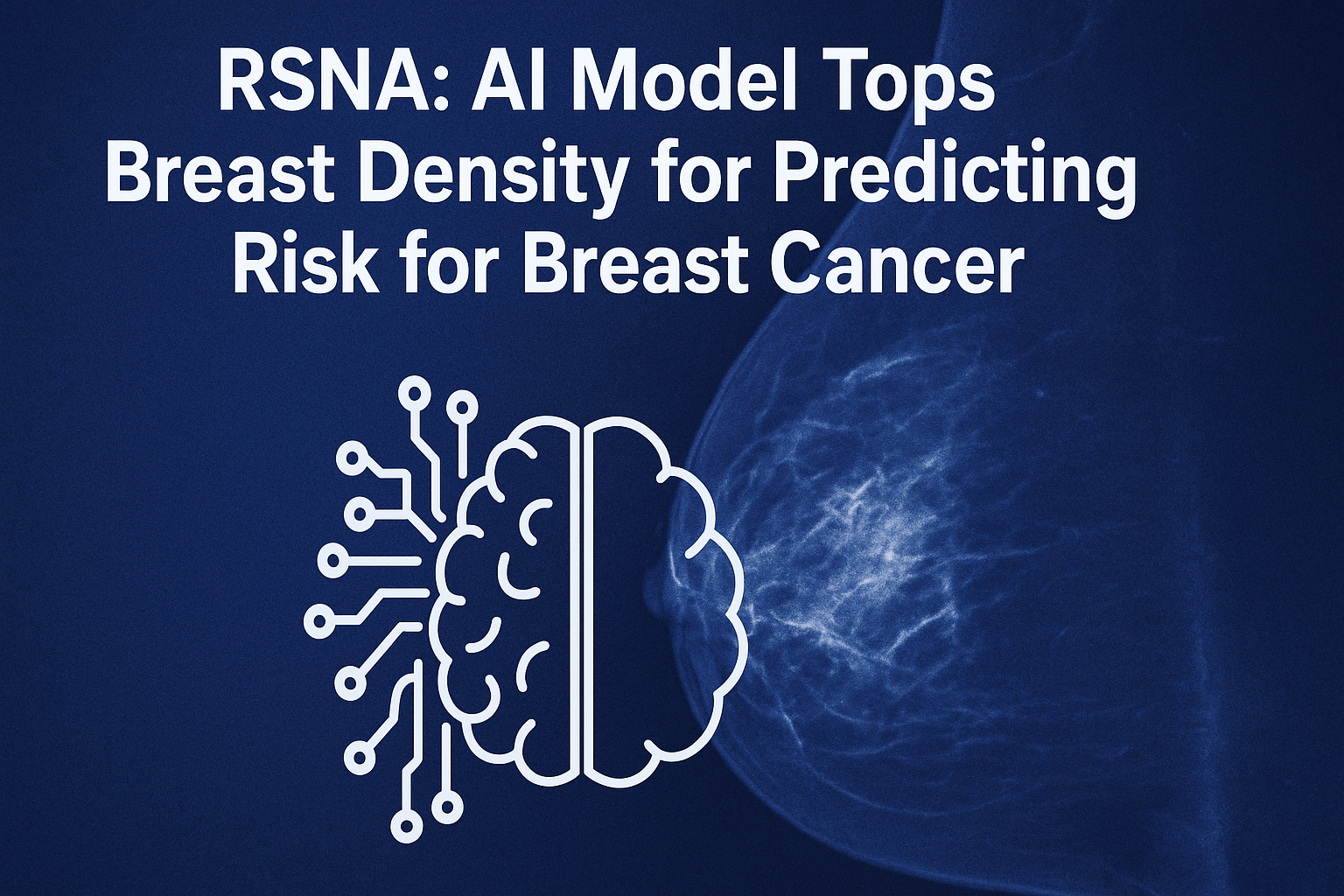
Study Findings Presented at RSNA
The AI model demonstrated significantly higher accuracy in predicting which women would develop breast cancer in the next 5 years compared to density-based assessments.
Key highlights include:
AI showed better predictive performance than the BI-RADS density categories.
The model correctly identified high-risk women even with normal-density breasts.
Predictions were consistent, while density ratings vary among radiologists.
AI provided standardized risk scores for all patients.
These capabilities position AI as a more powerful tool for early cancer risk identification.
Benefits of AI Over Breast Density Evaluation
a. Greater Accuracy
AI evaluates hundreds of imaging features, while density looks at only one factor.
b. Higher Consistency
Unlike human readers, AI gives the same output every time, reducing interpretation errors.
c. Earlier Detection
AI can predict risk before any physical signs appear, enabling proactive monitoring.
d. More Personalized Screening
Women with higher AI-predicted risk can be recommended for:
MRI
Ultrasound
More frequent mammograms
Preventive strategies
Impact on Different Population Groups
One major challenge in previous AI models has been lack of diversity in training data.
The RSNA-presented system was trained on mammograms from women of:
Different ethnicities
Different ages
Various breast densities
Multiple geographic backgrounds
This improves fairness, accuracy, and clinical reliability across broader populations.
Will AI Replace Radiologists?
The answer is no. Researchers made it clear that AI is a decision-support tool, not a replacement. Radiologists will continue to:
Interpret mammograms
Communicate with patients
Combine AI data with clinical history
Make final decisions
AI enhances their ability rather than replacing it.
Conclusion
The RSNA findings highlight a major advancement in breast cancer prediction. By outperforming breast density—long considered the strongest imaging-based risk factor—the AI model marks a new era in personalized screening. With its ability to analyze subtle tissue changes, deliver consistent results, and work across diverse populations, AI is set to transform early detection and support better outcomes for millions of women.