Everyday Chemist

Tapentadol versus Tramadol: How Does It Compare?

Tapentadol vs. Other Painkillers: How Does It Compare? Pain management is a complex field, with various medications available to treat different types and intensities of pain. Among the many options, Tapentadol stands out for its dual mechanism of action and moderate opioid strength. But how does it stack up against other common painkillers such as morphine, oxycodone, tramadol, and non-opioid analgesics like NSAIDs or acetaminophen? Understanding the differences can help patients and healthcare providers choose the most appropriate treatment.
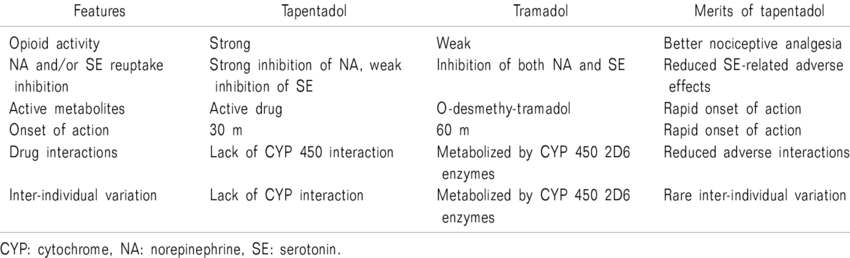

Table of Contents

What Is Tapentadol?

Tapentadol is a centrally acting analgesic with two distinct mechanisms:

  1. Mu-opioid receptor agonist – Provides traditional opioid pain relief by blocking pain signals in the brain.

  2. Norepinephrine reuptake inhibitor (NRI) – Enhances the brain’s pain-modulating system by increasing norepinephrine availability.

This dual action allows Tapentadol to relieve both nociceptive pain (from tissue injury) and neuropathic pain (from nerve damage), making it particularly useful in conditions like diabetic neuropathy, post-surgical pain, and chronic musculoskeletal pain.

Tapentadol vs. Tramadol

Tramadol is often compared to Tapentadol due to their similar dual-action mechanisms. However, key differences exist:

  • Potency: Tapentadol is about 2–3 times stronger than tramadol.

  • Onset of Action: Tapentadol acts faster and provides more consistent relief.

  • Metabolism: Tramadol relies heavily on liver enzymes (CYP2D6) to become active. Tapentadol is active in its original form, leading to more predictable effects.

  • Side Effects: Tramadol has a higher risk of serotonin syndrome and seizures, particularly when used with other serotonergic drugs.

Overall, Tapentadol is preferred for moderate to severe pain, while tramadol may be suitable for milder cases or for patients who cannot tolerate stronger opioids.

Tapentadol vs. Morphine

Morphine is a traditional, well-established opioid used for moderate to severe pain, especially in cancer or post-operative settings.

  • Mechanism: Morphine works purely as a mu-opioid receptor agonist, with no activity on norepinephrine or serotonin systems.

  • Potency: Tapentadol is less potent than morphine but may have fewer gastrointestinal side effects.

  • Neuropathic Pain: Tapentadol is more effective than morphine for pain with a neuropathic component due to its NRI action.

  • Addiction Potential: Both have a high risk for addiction and must be used cautiously.

While morphine is ideal for deep visceral or terminal pain, Tapentadol may offer a more balanced approach with fewer opioid-related side effects for chronic pain management. 

Tapentadol vs. Oxycodone

Oxycodone is one of the most commonly prescribed opioids for moderate to severe pain. Compared to Tapentadol:

  • Potency: Oxycodone is more potent milligram-for-milligram.

  • Side Effects: Oxycodone is associated with more pronounced nausea, constipation, and sedation.

  • Efficacy: Both drugs are similarly effective in pain control, but Tapentadol may have an advantage in neuropathic or mixed pain conditions.

  • Addiction Risk: Both carry similar risks, but oxycodone has a longer history of abuse, especially in high doses or when misused.

Tapentadol is sometimes chosen over oxycodone in patients with prior opioid side effects or those with neuropathic pain elements.

Our Products

Helpful Links

Send Us a Message

Full Name
Scroll to Top